Monday, July 25, 2011

Best Food and Drink in Northern Israel+Beyond

With less than 1 week left before we leave, I'd like to pass on our recommendations for the "best of" Israel.  Here are our favorites for food in northern Israel (with just a few from Jordan). 


·         Best cold drink: fresh squeezed orange juice on the beach or wherever you can get it from street vendors.  Yes, fresh squeezed – they get the oranges out of the fridge and squeeze them in front of you:

·         Best hot drink: Arab coffee.  Finely ground coffee simmered with cinnamon sticks, cardamom pods, and a little sugar.  Little sweet, little spicy, really gets you going. (see Small Addictions post for recipe)  #2 is mint tea with lemon—still tasty but with half the caffeine jolt.

·         Best cheap eats : Bruno Casa Della Pizza in Merkaz HaCarmel.  $10 buys you a slice of Pizza and a beer.  Not cheap you say?  It is for Israel…

·         Best humus: Humus Said in Akko.  Yes it’s kitschy, yes the locals all seem to have another favorite, but the only thing they make is great hummus and fresh pitas.  I know it’s totally inaccurate, but from now on, I’m going to picture ‘manna from heaven’ as the lunch we got at Humus Said.

·         Best falafel and Arab food: Arazim in Shlomi near Rosh Hanikra.  Tough choice this one, but they had the freshest salads and spiciest meat. Mmmmm spicy meat.  If you aren't in the mood for meat (or don't want to travel all the way to Lebanon), the best falafel is at Hazkenim in Wadi Nisnas Street in Haifa.  Awesome felafel+pita.  If you are in Haifa, you must try it. 

·         Best chef restaurant: Kimel in Tel Aviv.  The chef has his own TV show in Israel.  Very popular and very tasty!

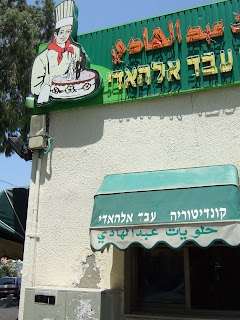
·         Best unique dessert: knefe, a Lebanese dessert made with shredded phyllo and cheese.  If you find it, you must try it.  If you don’t, settle for the delicious baklava from a local bakery.., Best bakery is in Wadi Nisnas down a small side street off of Allenby (near Shadaha on the northern/coast side of Khuri, ask if you get lost).  Look for the baker on the sign.

·         Best guilty pleasure: Gelato from Leggenda.  Ok, so it’s not indigenous, but it sure is tasty!

Best fish restaurant: Dag al HaDan on the Dan River.  This is a bit of a drive from Haifa, but it's one of the most unique dining experiences in Israel.  Diners are served fresh trout on the banks of the Dan River.  One wonders if the fish swimming in the river have any inkling about their impending doom.


And, last but not least, best hamburger (and best restaurant mascot) has got to go to Moses in Tel Aviv:


Outside of Israel:

We had some amazing food in Jordan.  If you happen to be in Aqaba, look up the Syrian Palace—great food, great service, great location. Al-Arabi in Wadi Mousa had the tastiest shwarma EVER!  Go there if you aren’t too exhausted from exploring Petra.

Best kebab+pita: The Grotto in Shepherds' Field.  If you're visiting Bethlehem in the West Bank, make sure to eat there.

Wednesday, July 20, 2011

A Helping Hamsa

In the Middle East, it helps to be lucky.  For hundreds of years, during Muslim, Christian, Muslim and Jewish administrations people in this area of the world believed in charms to defend against the "evil" eye and other misfortunes.  One of the most popular and enduring charms is the "hamsa," a palm-shaped amulet (pictured here):
Depending upon the faith of the owner, a hamsa amulet is either The Hand of Fatima(Muslim), The Hand of Miriam (Jewish) or The Hand of God (Christian), although the icon predates monotheism.  "Hamsa" means "five" in Arabic (like 'hamesh' in Hebrew) and the five fingers are reminders of the five pillars of Islam or the five senses of man.  The eye guards against the "evil eye," an ancient curse in Arabia, while the open palm represents blessing and providence.  Hamsas are usually placed near the doorway of a home to protect it and its occupants from any evil that might cross the threshold, although you can see them around people's necks, in cars, and in any room of the home that might need a little luck.

What I find most interesting is that the superstition was so strong the Jewish mystics in the Upper Galilee took up the tradition from their Arab neighbors.  The Hand of Fatima became The Hand of Miriam and the symbolism of five reinterpreted to mean the five books of the Torah. 

Today, the hamsa is so en vogue it's impossible to miss in the Jewish Friday craft fairs and Saturday Arab markets.  From Wikipedia: "In Israel today, it is a trendy symbol that has become 'an icon of Israeliness and secularity'."  The hamsa has been in the background of our own Israeli experience.  When we came here in February our apartment was graced with a malfunctioning doorbell in the shape of a hamsa (we did not recognize it at the time).  Upon planning our departure from Israel we were presented with one as a good-bye gift.  We've probably seen more hamsas than mezuzahs!

Perhaps it isn't so amazing that people from two strong monotheistic religions with no visible representation of God have agreed on this icon of "His" protection.  While the great invisible gods Yahweh and Allah remain in conflict, people embrace luck or fortune to keep them safe.  In a land of high risk, it doesn't hurt to be lucky.

Sunday, July 17, 2011

Meduzot (מדוזה)

It's July and, as we expected, it's hot and humid in Israel.  Haifa is averaging a high of 88F and a low of 70F with 65% humidity so it's not that pleasant for walking around.  When you drive inland, the humidity drops but the temps rise to +90F.  This is not a nice time for touring relative to April or May.  If you're planning a trip here, go before the end of June.  So now everyone is thinking "water" and we're sitting pretty right on the beach, with plenty of sandy shore access and a beautiful swimming zone just across the street.  The only problem is that relatively no one is in the water.
 
The first problem is the waves.  We've seen some of the biggest breakers come in from June to July (bigger than they were in March) and swimming is not safe even though there's no storm in sight.  Today is sunny and hot and windy but the waves are in the 6ft range and too dangerous for swimming.

The second problem is the jellyfish or meduzot.  I learned the Hebrew name because yesterday I had a close encounter with one and the lifeguard was the only thing that saved my face from a mass of stinging tentacles.  The waves were up, but still swimmable.  I was trying to get pictures of the local fish for my blog and was focused on chasing a small tillapia.  Suddenly, the lifeguard shouted at me: "meduzot!" but I didn't understand so he switched into English.  "Lady, there is a jellyfish, right there." Sure enough, there it was, about 1 foot away, a blue jellyfish with a 6 inch bell.  I got to my feet and backed away from it, but it must have had a cousin or something because no sooner had I stood up then I felt two stings on the backs of my legs. 

The pain related to them was somewhere between a wasp and a bee sting, so not horrible but not easily ignored.  We had both been stung before with the small broken bits of tentacles that float in the water, but these stings were much more intense.  That ended our swimming for the day and the stings went away in about 2 hours. 

One of my coworkers insists that from July-August she swims exclusively in the fresh water of Lake Kinnereth (Sea of Galilee), and, having been stung, I don't blame her.  In Tel Aviv we saw schools of 8-10 jellyfish with 1 ft bells floating in the waves and I've seen even larger ones off the coast of Dado South Beach in Haifa.  We wear UV shirts to protect our arms and upper bodies so we're pretty safe and usually it's easy to avoid the meduzot when the water is calm.  Dealing with jellyfish is just the cost of enjoying a nice swim in these hot summer months--the water itself is 82 degrees and very refreshing!

Jellyfish identification chart (we usually see the Drymonema type):

If you have a strong stomach check out pictures of a much larger jellyfish school that shut down a power plant just north of Tel Aviv:
http://www.dailymail.co.uk/sciencetech/article-2011565/Jellyfish-shut-power-station-amid-claims-climate-change-caused-population-surge.html

Pictures of the jellyfish that washed up this weekend (each white blob is a different stinger):

Thursday, July 14, 2011

Shabbat and the City (Tel Aviv, part 2)

Tel Aviv certainly is "cool."  There's a vibe about the place unlike Haifa or Jerusalem.   The Friday markets are crowded and fun.  Everything is on display for the public.  It is a place to see and be seen.  Hip stores vie for attention on the boulevards while farmers hawk piles of cherries in the plaza.  It is a kaleidoscope of color.  Restaurants (at least the ones we tried) are extremely good.  However, like all of Israel, it suffers from the tyranny of Shabbat.

Everything that was exciting and cool--the markets, the restaurants, the trendy shops--everything like that, is completely gone by Saturday morning.  Some restaurants and coffee shops are open which is a small mercy, but the majority of the city is closed.  Plazas are devoid of life.  Large boulevards have no traffic.  Shops are shuttered or display their wares in windows with one light on, as if to mock and say "come back later."  It's like a war-zone and everyone has gone to ground.  The city is empty.


Everyone is at the beach, and I do mean everyone.  The entire city lives by the "shop on Friday, beach on Saturday" cycle also common in Haifa. From an American point of view, this is just too much conformity.  I can go to the beach and enjoy it on Friday while the people are elsewhere, but I can't go shopping on Saturday to avoid the beach crowds.  Silly … 

Beach on Friday


Beach on Saturday

There is also no public transportation from Friday afternoon until Saturday night.  Come to Tel Aviv on the train on Friday and you're stuck until 9:10 p.m. on Saturday.  This might work if you can crash with family or friends, but a night in a Tel Aviv hotel is not cheap ($200+).  It seems like the rules have been made to benefit the natives or the tourists.  Tel Aviv works well if you live there, like to party all night on Friday and sleep on a beach chair, or don't work a normal week. 

Still, it was good to see the city and to be able to stay over on Thursday and Friday nights.  The restaurants were the best in Israel which made it worth it to have two dinners in the city.  We were too tired to take in the fabled night-life scene but given what I've seen in Haifa and Jerusalem, Tel Aviv is the only place you can go out for a "night on the town" in the entire country, so any bar would be like New York crossed with Miami crossed with Vegas.  We overheard one person at the beach saying that he got to sleep around 5:30 a.m. on Saturday morning.  No wonder Shabbat is so quiet--everyone not at the beach is sleeping off a hangover.  Tel Aviv ranks high on my list of Israel experiences, but I still think Haifa with its natural beauty and pleasant beach is definitely the best place to live!

Sunday, July 10, 2011

The White City (Tel Aviv, part 1)

In 2003 UNESCO awarded Tel Aviv the title of "White City" to honor its unique collection of Bauhaus architecture, but based on our experience this weekend, Tel Aviv is anything but white.

White implies a bland cleanliness and sterility that is completely absent from the city as it exists today.  Tel Aviv is colorful, dingy, and eclectic--a far cry from the modernist regularity envisioned by its early builders.  Walking around its wide boulevards and public squares built from 1930-1950 you feel like you're in a lived-in and past-its-prime Tomorrowland. 

In its structures you recognize an unfailing optimism, a belief in progress and conformity--the simple line, mass-market appeal and instant accessibility.  As Tel Aviv materialized out of nothing except some sand dunes north of Jaffa, it came to life in this form--bright, white, and centrally-planned.  The city was a blank palate and they designed to point firmly towards the future.  In this architecture there are no cultural elements, no ethnic tensions, or diversity of form which is exactly the vision that early Israelis had for their country: a new Jewish homeland that celebrated equality and hope ("aviv" means the season of spring).  What better way to forge a new society out of random immigrants than with an "international" style and a bucket of white wash?


Today, perhaps like the original dream of equality without ethnicity, some of Tel Aviv's houses are in need of repair.  Many of the old houses are getting a nice retrofit.  White paint is being replaced by mint greens, warm yellows and tans.  Each one has developed a unique character, although for some, the character is decay.  We stayed with a friend in a building built in 1928.  The insulation is terrible and the air conditioning insufficient and the whole place is showing its age.  In a few months, all of the tenants there will be evicted as it shuts down for a retrofit.  You can see why.  The neighboring houses are either construction sites or already improved luxury boutique hotels and residences.  The location is one of the finest in the city and there's money to be made in the up and up Tel Aviv real estate market.  The investments, however, remain uneven and for every three-storey apartment building undergoing a neo-modernist renovation, there's another crumbling to gray dust.


In some cases that's ok as the houses that crumble are bulldozed away to make room for more glitzy glass towers.  Tel Aviv is once again looking like a city of the future.  Real estate prices in and around the city have gone through the roof and there's talk of making Tel Aviv into a mini-New York City.  Trump and other big-name developers have invested in large luxury towers along the beaches and cranes are a prominent feature in the skyline.  Since the Bauhaus apartments are all low-rise 3-4 storey boxes, the planned 43-storey towers should have a nice view.  Which begs the question, who will live here? 

Tel Aviv is a youthful city in which the youth are being priced out (just like New York).  With the US real estate market in shambles, perhaps the bankers of New York are now betting on Israel's center of "cool," but it seems like a condo in Miami would be a safer investment than one in Tel Aviv (within the range of rockets launched from the Gaza Strip).  On the other hand, if you read the demographic tea leaves, Israel is slated to grow and the "it" place in Israel is definitely Tel Aviv so demand to live in the city is going to remain strong for years to come as long as the security situation remains stable and the economy here keeps humming away.  Like I mentioned before, Tel Aviv, is founded on hope and optimism.

Wednesday, July 6, 2011

Saving the Best for Last

Yesterday we joined a coworker and her boyfriend in Tel Aviv for dinner.  When we met up and explained that, although we had been in the country since February we had not yet been to Tel Aviv, her boyfriend lit up.  "Welcome to Israel," he declared with a broad grin.

To most Israelis, Tel Aviv is the center of the world.  Jerusalem may have all of the old religious landmarks but Tel Aviv is the cultural soul of this relatively young state.  It was in Tel Aviv in 1948 that David Ben-Gurion declared the independence of Israel as the first sovereign Jewish state--a state that would "uphold the full social and political equality of all its citizens, without distinction of religion, race," while still allowing the "Jewish people to be masters of their own fate."  The secular vs. religious tensions apparent in the Declaration are still plaguing Israel today.  Jerusalem is the religious side--strongly orthodox and very proud of its religous ceremonies.  Tel Aviv is the secular side, the 83% of the Jewish population (Jewish in ethnicity and tradition) that cares more about enjoying life than fighting over territory.  It's a refreshing and playful breath of multicultural fresh air.

Take the restaurant we went to as an example--"The Diner by Goocha."  Goocha had been a seafood restaurant serving everything from fried calamari with parsley and garlic aioli in classic Italian style to a seafood noodle dish cooked in coconut cream and thai peppers.  Last night was just a week after it had been remodeled to look like a traditional American diner.  The menu had changed to include items such as rib-eye "chops" with Hollandaise sauce and New York Cheesecake.  They had even lined the walls with chalkboards to give it the straight from Chicago or New York look.  Everything was new and shiny and it was packed, in the middle of the week, from 8:00 and later.  We left at 10:30 and it really seemed like the city had just started to wake up.  We hear that some restaurants will stay open, serving dinner items well past 2:00 a.m!  Want a bacon cheeseburger at 1:00 in the morning?  Tel Aviv is the place to get it.


We heard from our host that rollerbladers started a protest on Tuesday nights.  They gathered at 10:30 p.m. in such numbers that they shut down the streets and caused traffic jams.  Instead of arresting them the cops worked with them to create a rollerblading route of select streets that are closed from 10:30-12:00.  Now it's more of an event than a protest.

We're going back this weekend because it is an interesting place and it seems a little more like America in its hedonistic pleasures and stay-open-late (even on Shabbat) freedoms.  The food is great and the attractions are supposedly good as well.  How could we leave Israel without visiting it first?

L'chaim!

Monday, July 4, 2011

Family Values

When my coworkers were asked what their top three values in life were, "family" was a unanimous favorite.  In a work setting, when values could be anything from "success" to "developing my career," they chose "family."  I was surprised, since I would not expect the same result among my American colleagues.  Sure, family would be high on their list of personal values, but I don't think they'd be that honest about it.  Would you tell your manager point-blank, work is not the be-all and end-all of my universe?  Maybe...The ranking we gave our values was more or less the same as his own.
They were surprised that I, an American, was in full agreement.  Family has not traditionally been the stated top value of the American businesswoman.  It is either unstated or not that important, but I think the times are changing.  In my generation, more Americans are less interested in the economic or business definitions of success.  Give me enough money to ease my worries, enough status to feel useful, enough activity to fill my day, but work is work and life is what happens in the home.  This was a value that I learned during my six months in Germany (of all places!) and it has led to a very contented lifestyle. 
The Israelis seem to hold family even closer than we do.  In this tiny country, grandma and grandpa are never more than 2 hrs by car, and brothers and sisters don't move so far away.  Families are both large and close-knit.  During Shabbat we have seen restaurant tables taken over by generations of family all sitting together for the breakfast meal.  Grandma and grandpa, aunts and uncles, young parents and younger kids all gather together, and not just for the holidays. 
Demographers estimate that each Israeli couple has an average of 3 children.  That means, unlike Europe where the favorite child is a dog, Israel is growing and growing younger.  Children are the future and the Israelis are very optimistic.  Like one of my coworkers said, "Kids are joy."  My coworkers have between 2 and 3, so they are definitely doing their part.
Family is the center of life and kids are the center of family.  What this leads to is a very kid-friendly country.  Our beach has a separate kiddy pool with its own lifeguard.  In swimming zones lifeguards admonish the children when they rough-house in the waves.  Restaurants have kid menus; shopping malls have kid zones; even my workplace has a day care service.  Now that it is summer vacation, some workers even bring their kids to work and they hide out in the cubicles or the lounge areas.  Kids are generally well-behaved in public spaces so no one minds.   It's common to see a woman shopping while holding a little girl with one hand and a stroller with the other.  Grandma may even be close by to help.
This is so very different from life in the states when families split up and live in different time zones.  Maybe this is changing due to the recent recession drawing kids and parents back together, but the cost of our expansive geography has often been separation in favor of individualization.  If the job is in one state and family in another, we Americans are more apt to move for the job.  In Israel the job will never be far from family--move from Beersheba in the extreme south to Nahariyya in the north and you are 3 hours apart by train!

So my thoughts for this Independence Day: celebrate all that is good in America--our freedoms to travel, to eat pork ribs, to indulge in a bacon cheeseburger 24/7, but don't forget to include your family.